Showing posts with label fishing. Show all posts

Wednesday, April 9, 2014

Chronicles of a Patagonia Road Trip: Part III

Crossed into Chilean Patagonia for this portion of the road trip. Saw some breath-taking scenery, stumbled upon a friend’s home, camped in some amazing places and took the single-lane, gravel Carretera Austral back to Argentina. It’s been quite a ride…


Day 9

"We lost our brakes on the way to San Martin de Los Andes. Turns out you can't cross the border to Chilé with 60 litres of gasoline strapped to your roof, so we decided to burn the gas by giving a lift to a couple of French hitch-hikers we met earlier today. Whether it was the gravel road shaking the truck to death, or just regular wear and tear over the course of thirty years, we were literally dumping brake fluid down the mountain pass to town. But I'm not surprised that the brakes failed. We've learned to take everything in stride. Instead of letting the truck get us down, we're going to make the most of our time in Patagonia. We celebrated safely arriving here with a steak, which turned out to be the best I've ever had."


Day 11

"The beauty of having your own vehicle is that you can choose your own route. We crossed into Chilean Patagonia at Ruta 231 and planned to take some smaller roads that weave between the Siete Lagos in search of some fishing spots. While I've heard that Argentina's portion of Patagonia is more stunning, I'm not convinced as I look at the snow-capped peaks towering over the lakes and grazing fields."


Northern Chilean Patagonia


"Spending the night in Puerto Varas. After seeing the amount of snow and wind this far North, I need to purchase some last minute gear before venturing any deeper into Patagonia and this looks like the place to do it. We had some tapas for dinner at a ridiculously expensive restaurant, where we heard from the camarero that an 8.0 earthquake just hit Iquique in Northern Chilé. If Tom and I had stuck to our original timeline and not left Peru as early as we did, our schedule would’ve put us right in Iquique for the earthquake. Something to think about as we return to the truck and call it a night.”


Day 12

"We're starting to get deeper into Patagonia. Took a ferry from Puerto Montt to a gravel road that eventually led us to Hornopirén. The ocean, pristine forests, and rugged peaks surround this quaint fishing town. Made a new friend, a stray, who we dubbed ‘Horno’ after Hornopirén. Fed him a can of tuna after he accompanied us through town and I don’t think he’ll be leaving our side for quite some time.”


Ferry

Carretera Austral

Hornopirén, Chilé


Day 13

“No luck starting the car this morning, even by popping the clutch… With two large Russian lads, Vladimir and Dmitri, pushing from the back, and a truck pulling from the front, we managed to get our truck on the ferry just in the nick of time. Can’t help but laugh at how right Tom was in preparing for the worst, which stems from his military background. I thought he was anal when he insisted on buying shovels, tow ropes, extra gas cans, etc., but we’ve used each and every one of them. Hope for the best, plan for the worst… Oh, and Horno did accompany us on the ferry. We planned on taking him to Ushuaia with us so he could be the world’s most travelled perro, but he wouldn’t get in the truck. I hope he doesn’t perish on the tiny, uninhabited island we left him on…”
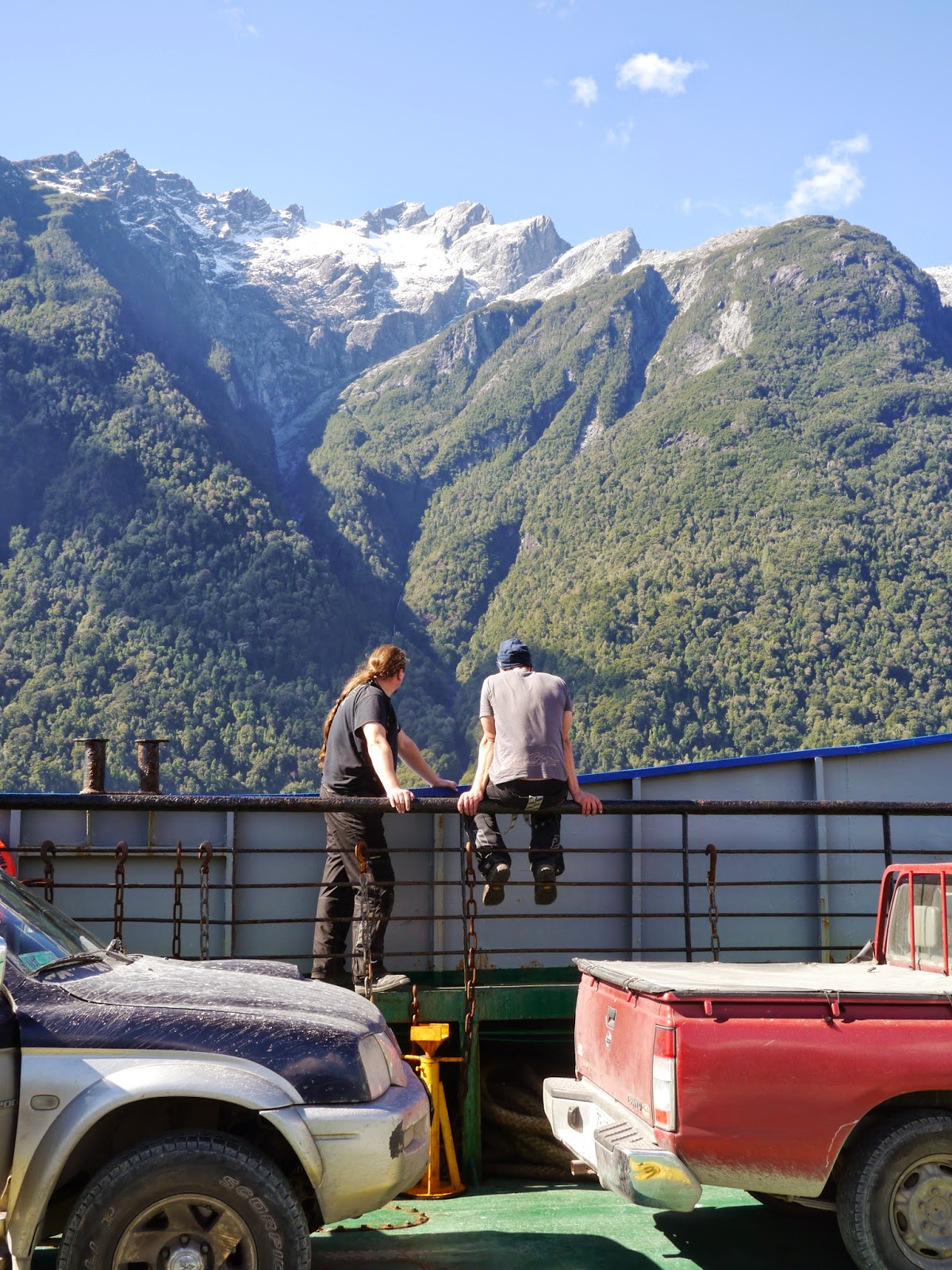

Vladimir & Dmitri on the ferry

Our stray, Horno

“It truly is a small world. We picked up a Belgian hitch-hiker on the ferry, Virginie, who needed to get to a hospedaje in Chaiten in which she was going to work for a month. We pulled-up along side the place when I noticed a sticker on the truck in front of us, a ‘Tribe’ sticker. ‘Tribe’ is a group of kayakers that I know from back home, from my time paddling the Ottawa River. I asked the owner of the place, Javier, if he knew who the truck belonged to. It was his son’s, Marcos Gallegos. I was shocked. I knew Marcos from paddling in Canada and here I am, just happened to stumble upon his home. I learned that he was on his way to the White Water Grand Prix in Canada. Talking to Javier I discovered we shared a bunch of mutual friends because he hosted the athletes from the previous WWGP. After several cervezas and laughs he fired up the grill – a fiesta was under way. Fresh salmon, sausages, chicken and pisco, lots of pisco, was consumed. Javier wouldn’t let Tom and I sleep in the truck and offered us warm beds to sleep in. Gotta love the whitewater kayaking community.”


Tribe

Tom and I with Javier and our hitch-hikers

Fresh Salmon

Cooking for the fiesta


Day 14

“I’m a little disappointed to be so close to some of the world’s best whitewater, namely the Futaleufu, and not being able to paddle it. Especially since the futaleufu is what sparked the dream not only to travel to Patagonia, but to come to Latin America in the first place. I remember seeing pictures and films of the Fu as a child and dreaming of the day I would be able to paddle it. I’m trying to not let it get me down; I’m trying to convince myself that I’ll be back someday, back solely to paddle. I’m focusing on the fact that I’m in a place that few will ever have the opportunity to see. There are pristine forests, mountains and glaciers at every turn. The only sign of development is a single lane, gravel road – the Carretera Austral – carving its way south.”


Day 15

Despite not covering much ground, we had a good day today. On the way to Lago Tranquilo with our two new hitch-hikers from España, we hit a chicken. As Tom was cutting its neck to finish it off, a Chilean woman came running out shouting, 'Necesitan pagar! Necesitan pagar para el pollo!" After explaining that we hit it and were simply putting it out of its misery, she stopped demanding payment and took the chicken for herself. I'm a little disappointed that we're not eating fresh chicken tonight... But at least we have a top-notch campsite free of charge. We hopped a fence to sleep in a pasture under a huge tree by Lago Tranquilo after being assured that Chileans are 'muy sympatico' to travellers in our situation. Had a nice fire, some vino tinto, and conversed in Spanish with our new amigos. Feels great to be able to hold a decent conversation in a foreign language."

- Buena Onda


Friday, December 6, 2013

Gringos in Aserradores


“There ain’t shit going on in this town… but I’m glad I got to experience the real Nicaragua.”


Before I set off for my journey I had the naïve illusion of myself being the lone gringo amongst the locals, conversing in Spanish and being invited to take part in their customs and traditions. Upon arrival to Central America, however, it quickly became apparent that this would not be the case; many towns, especially surf towns, were geared toward tourism. It was in the small fishing town of Aserradores that I had come closest to realizing this dream.


Aserradores (A) was in the middle of nowhere, it was tough getting anyone to take us further than Chinandega

Encountered this a few times during the drive into Aserradores


Aserradores was just about as far North as one can get on the Pacific coast of Nicaragua. It was the logical stop after Granada because it had surf breaks, would allow me to see a completely different area of the country and was along the way to Honduras, where several friends of mine were destined. After much difficulty arranging for private transport, we arrived in Aserradores in the afternoon of November 29th, 2013. The fact that no one was eager to drive us there should have been an indication of how far off the beaten track we were straying.
Aserradores was a tiny village situated by an estuary of the Pacific Ocean. The nets hanging outside nearly every home attested to the vibrant fishing industry in the community. There were no grocery stores, restaurants, or large hotels. Several homes doubled as pulperias from which people could buy sweets, pop and, occasionally, fresh vegetables and meat. We stayed about a forty-five minute walk outside of this small village, not on the beach, but in a cabin alongside the farms on the outskirts of town.


Aserradores

Fishing nets were being mended or hung-out to dry outside nearly every home
The cabin and campsite

Cooking up some grub


The cabin was in the far back corner of a long, narrow property. It was a small, wooden cabin equipped with a propane stove, basic electricity but no fridge, and an outhouse. While Ross and Kate stayed in the cabin, Tom, Jaylynn and I elected to camp outside by the orange and lime trees that were ready for the picking. Every morning I would wake in my tent to the sound of horses, pigs and chickens grazing in the field.


Just a typical morning

Babe

Cool bird


Aserradores is home to one of Nicaragua’s most famous breaks, ‘The Boom’. It is a steep beach break that causes the swell to jack-up at the last minute creating incredibly fast and hollow waves that dump no more than several feet from shore, in only a couple feet of water. Accordingly, many boards break here and it is expected of surfers to bring a quiver of sticks. Unfortunately, there was absolutely no swell that rolled in and no surfing to be had. While I came for the surfing, I got something completely different out of my time there.

I felt as if it was my first authentic cultural experience in Latin America. While one would expect for one of Nicaragua’s top breaks to spur development and attract tourists, this was clearly not the case in Aserradores – at least, it has yet to happen. There were a couple of all-inclusive surf resorts along the coast, but only one hostel in town run by a Portugese-American named Joe. The first piece of evidence that this area was seldom travelled occurred one day on the black-sanded beach of Aposentillo when a family of over half-a-dozen asked us if they could take a picture with us, the gringos.


Playa Aposentillo

Black sand


There was poverty in Aserradores, and its residents clearly led a different life than that which we are used to in the Western world. The houses were made of wood and tin and, in places, openings were patched with cardboard boxes. A common sight was seeing a whole family packed on a single motorcycle, with the infants squeezed between the adults on the seat and the older children on the gas tank and handlebar. Of course, none wore a helmet. From 7:00 to 12:00 the children were in school, all in the same class no matter the age. Here they studied every subject that children do in our schools, except for English. This may have been due to the lack of an English-speaking teacher, as I did not meet a single local who spoke the language.


Ross hard-at-work with the coconuts

Tom snacking on some coconut meat

First harvest provided plenty for snacking and home-made orange juice for screwdrivers


Despite the poverty, the locals were the kindest and friendliest people. I’d have to greet every person I passed on the street and, occasionally, attempt to carry out a conversation with them. The neighbouring children were understandably the most curious with us gringos and spent most of their free time at our cabin. They taught us how to gather oranges from the thorny trees and entertained us with their fire-crackers made of gunpowder wrapped in newspaper. My photos of the snow-covered mountains of Western Canada amazed them, and they were thoroughly entertained by my digital camera, with which they ran around taking countless pictures of anything and everything. They also found it particularly funny to watch me practicing Spanish with some audio tapes.


Neighbourhood kids laughing at my Spanish lesson

A couple of the local kids


In addition to getting a taste of rural Nicaragua, I experienced a phenomenon that I reckon only few have had the opportunity of doing, skinny-dipping in the Pacific Ocean with bioluminescent algae.  As you can imagine with no surfing to be had, we had lots of downtime in our rurally-situated cabin. One evening, several drinks deep, we all decided it’d be a good idea to trek to Playa Aposentillo for a swim. As we swam in the Pacific under the clear, star-spattered skies we noticed countless yellow/green –coloured lights trailing our movements – bioluminescent algae. Supposedly once a year the deep, cold water of the Pacific Ocean ascends to the surface, carrying with it this bioluminescent algae. When looking at the ocean it was completely black, but any of our movements caused the algae to fluoresce. It seems that alcohol doesn’t always lead to bad decisions, for if it wasn’t for our Coke con ron we would’ve surely missed this opportunity.

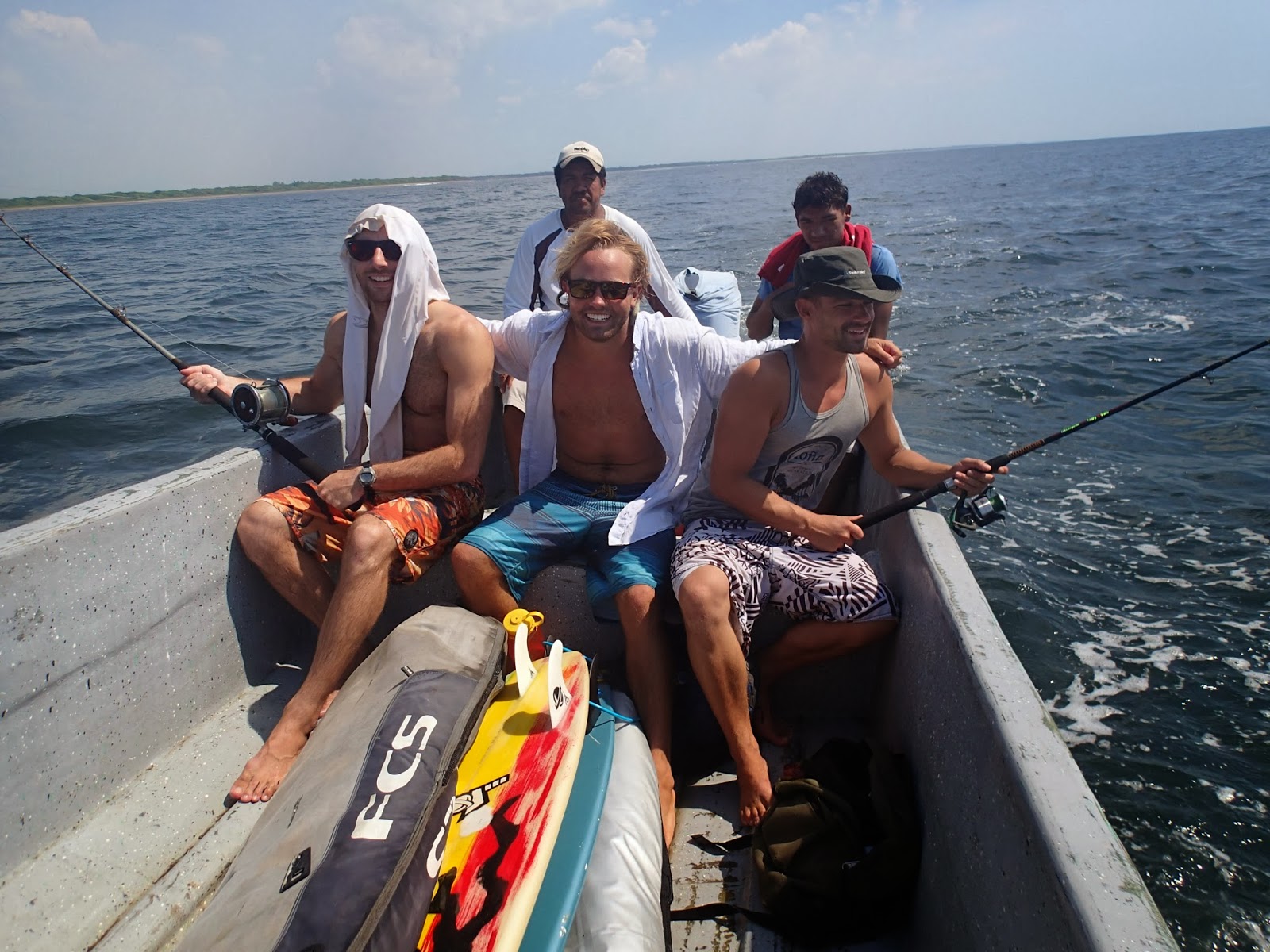
Our last day in Aserradores did not disappoint either. In fact, it surpassed all of our expectations. One evening at Joe’s place, the only hostel in town, Joe noticed that we were a little down about the waves and suggested we check out Maderas Negras, a river-mouth break that pumps out waves when neither the ‘Point’ or the ‘Boom’  are working. A couple of days later, on our last day, we woke in the early morning, strolled into town and hopped in a boat headed for Maderas Negras. We dropped a couple of fishing lines and trolled along the way. About fifteen minutes in, Tom managed to hook and reel in a large mackerel. Ten minutes later we were anchored behind the break and getting ready to surf.


Ross fishing on the way to Maderas Negras

Kate and Tom with the catch-of-the-day, holy mackerel


Approaching an unfamiliar break from behind was a wild experience. I did not know the size of the waves nor their shape. As I paddled closer I had to keep checking over my shoulder to see if anything was building up behind me. The waves were clean, breaking well both right and left. I had a fantastic session and surfed until I was completely exhausted, which was not such a bright idea. Normally if I were tired I could just surf on into shore and call it a day. I failed to remember that once done, I had to paddle out past the break to get back to the boat. Already dead tired paddling toward the boat, I saw the perfect wave building just in front of me and I couldn’t resist turning around and catching a final ride. I road it into shore and, satisfied with the surf session, started paddling back out toward the boat. It was the worst paddle I’ve ever had to do. I didn’t have an ounce of energy left, my arms felt like noodles and I was hardly covering any distance between the crashing waves. About twenty minutes later I made it back to the boat exhausted, but thrilled about the session and the fresh pescado we would be having for dinner – and, pardon the pun, but holy mackerel was it ever good.


Anxiously waxing our boards for the first surf in nearly two weeks

Approaching the break from the back

All stoked about the surf session and fresh pescado we'd be having for dinner

Filleting Tom's mackerel

Melody frying up some sweet plantains for dessert


While I was a little disappointed at first when I arrived to Aserradores and there was no swell, I can’t express how grateful I am that we found this little cabin. Truly interacting with the locals in rural Nicaragua, skinny-dipping with bioluminescent algae and a boat trip to surf Maderas Negras were not expected from Aserradores, but I’m stoked to have been able to share these experiences with Ross, Tom, Kate and Jaylynn. We split in Chinandega and all head our separate ways, but hopefully we’ll cross paths in the future. Next week I’ll be back in Costa Rica, meeting up with mis amigos Mark and Tarapacky from back home!

Pura Vida

Blogging time

Tom, Jaylinn, Kate and Ross

Thursday, November 21, 2013

A Day in the Life of a Castaway in Nicaragua


All good things must come to an end, and, unfortunately, after three amazing weeks at Castaway it was time to move on. As a tribute to this fantastic experience I thought I’d paint a picture of a day in the life at Castaway…


San Juan del Sur


As you may have gathered from the previous blog post, Castaway was fairly secluded. About once a week we’d make the trek to San Juan del Sur to stock-up on supplies, get some internet access and re-join civilization. After one night in town, however, we’d be itching to get back to the paradise that is Castaway.

Over the course of the three weeks I had developed a daily routine: surf, fish, cook and, of course, save sea-turtles. The breaks around Castaway were very tide-dependent, with high tide bringing the best waves. Spoiled by the private break just steps from our front-door, the idea of a fifteen-minute hike along the beach to Playa Maderas just to fight the crowds over a wave was ludicrous. Accordingly, I tended to surf the former. When a big swell rolled in, however, the trek to Maderas was worth it. The crowds would thin-out as the waves grew well overhead, people would be getting barreled left, right and centre and you would surely catch the ride of your life.


The private, front-door break

Tom paddling out to our front-door break

Surfing another nice left outside my front-door
The size of the swell on my final surf session at Playa Maderas


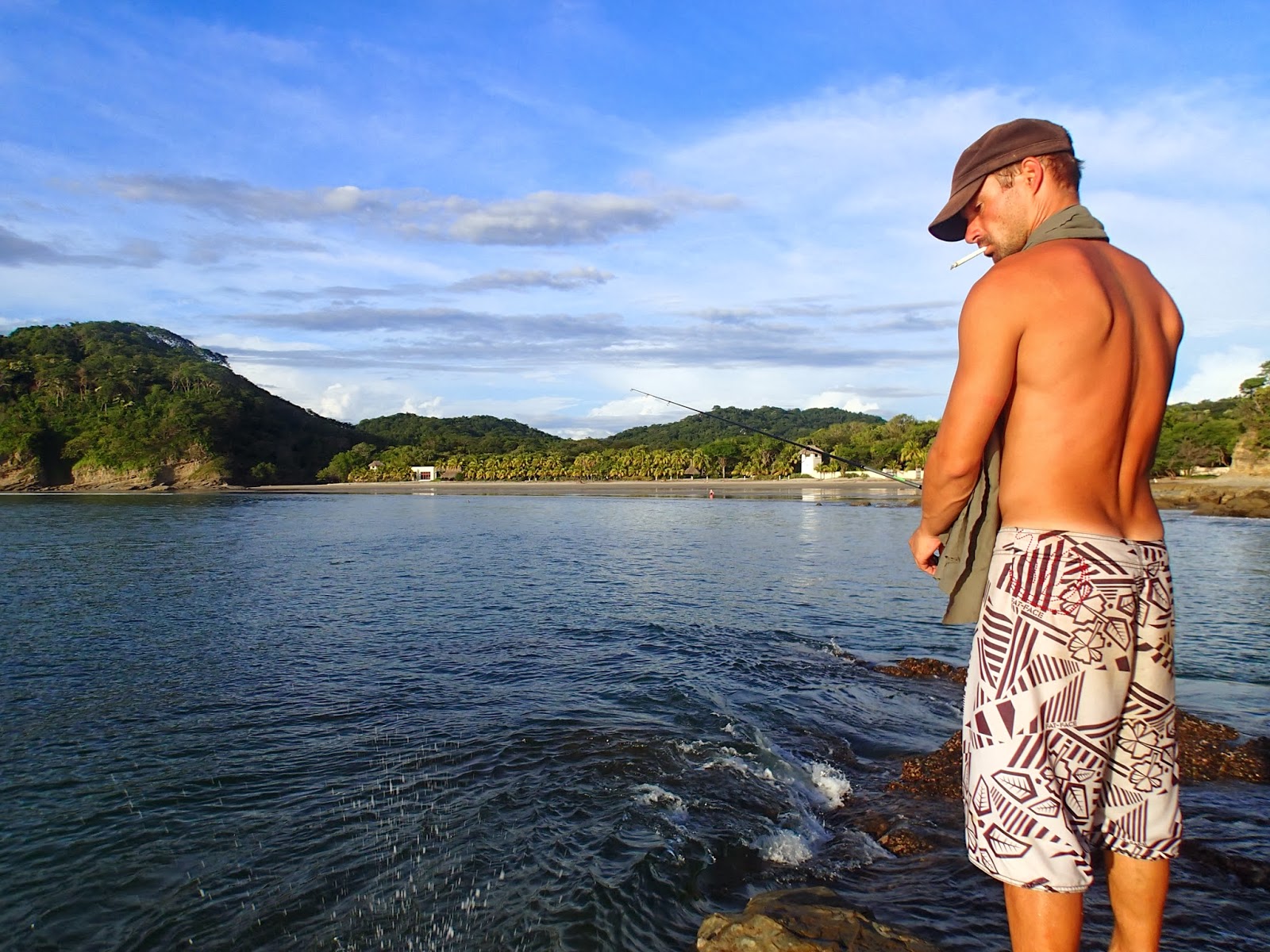
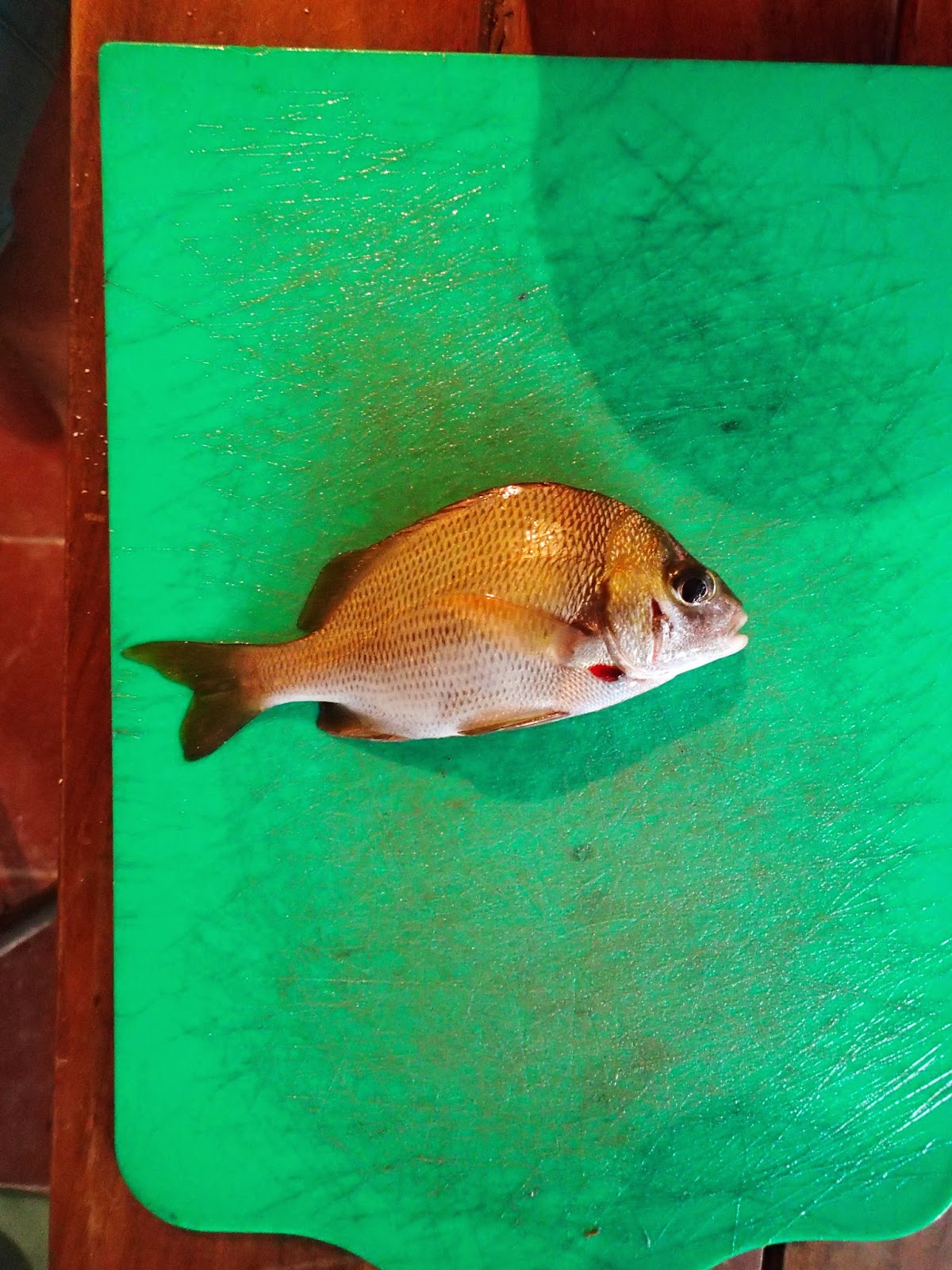
As the tide receded and the surf got worse, it was time to try to catch some supper. We’d equip ourselves with fishing rods, spears, snorkeling gear and a mesh-bag tied to a plastic bottle in which we could store our fish while continuing to hunt. Playa Majagual was our favourite spot to fish. It was sheltered within a bay preventing large swells from kicking-up sand from the ocean floor and reducing visibility. It also had large rock outcroppings around the side of the bay providing both places to stand when using a fishing rod, and a habitat for the fish to hide in. Underwater currents, coupled with the poor visibility of the Pacific Ocean, sometimes made the rocks difficult to negotiate; while diving between the rocks I would have to constantly fight the various currents from pushing me into the sea-urchin-coated rocks, which was made even more challenging the days visibility was no more than three feet. However, the jelly-fish, eels, and various types of colourful fish I would see and try to catch made it worth it.


Tom at work

Sea urchins

Guineafowl pufferfish

More ocean life

Stoked to have finally got some pescado

Catch-of-the-day

In times we lacked fresh pescado for dinner, which, unfortunately, was more often than not, we’d be able to rely on the food truck that came twice a week. I would wake in the early morning to the sound of ‘papaya-piña-papas-pollo-banana…’ blaring from the speakers mounted on the pick-up truck. Everybody would crowd around the truck and purchase whatever fruits, vegetables and chicken they desired. No matter how many pineapples, papayas, bananas, chickens and vegetables I bought, it was difficult to get the cost over 100 córdobas ($4 US).

In the evenings we would start a bonfire on which we cooked our dinners. We’d put on some tunes, have some drinks that we purchased from Juanita’s Kitchen next door and start grilling. We had it down to a science – when to put in the potatoes, how to grill the chicken to perfection and even how to make a strong cup of coffee out of the top of a plastic coca-cola bottle. It was always a blast having everyone come over to cook and enjoy the beach bonfire.


Another night at Castaway
Beach bonfire grilling

Finished product


Coca-cola bottle -filtered coffee


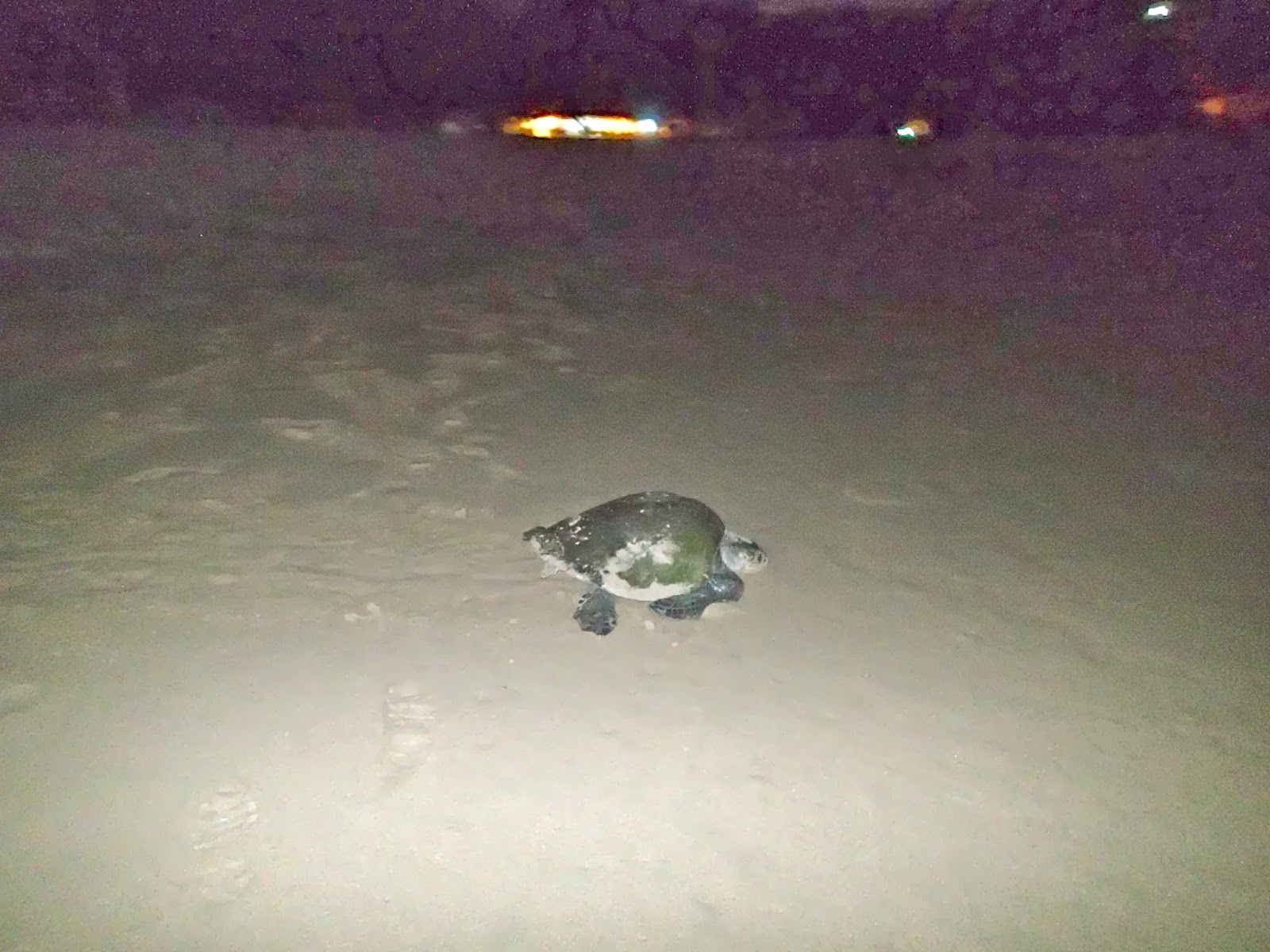
Every once in a while I would wake late in the night or early in the morning to help Douglas with the sea-turtles. Over the three weeks I got to see everything from fully-grown turtles climbing onto shore to the baby turtles making their way to the ocean.


Olive Ridley Sea Turtle
More baby Olive Ridley sea turtles

It was a blast, but it was also time to see what else Nicaragua has to offer. For the first time in two months I'll be leaving the beach and heading inland for some much needed rest from surfing.