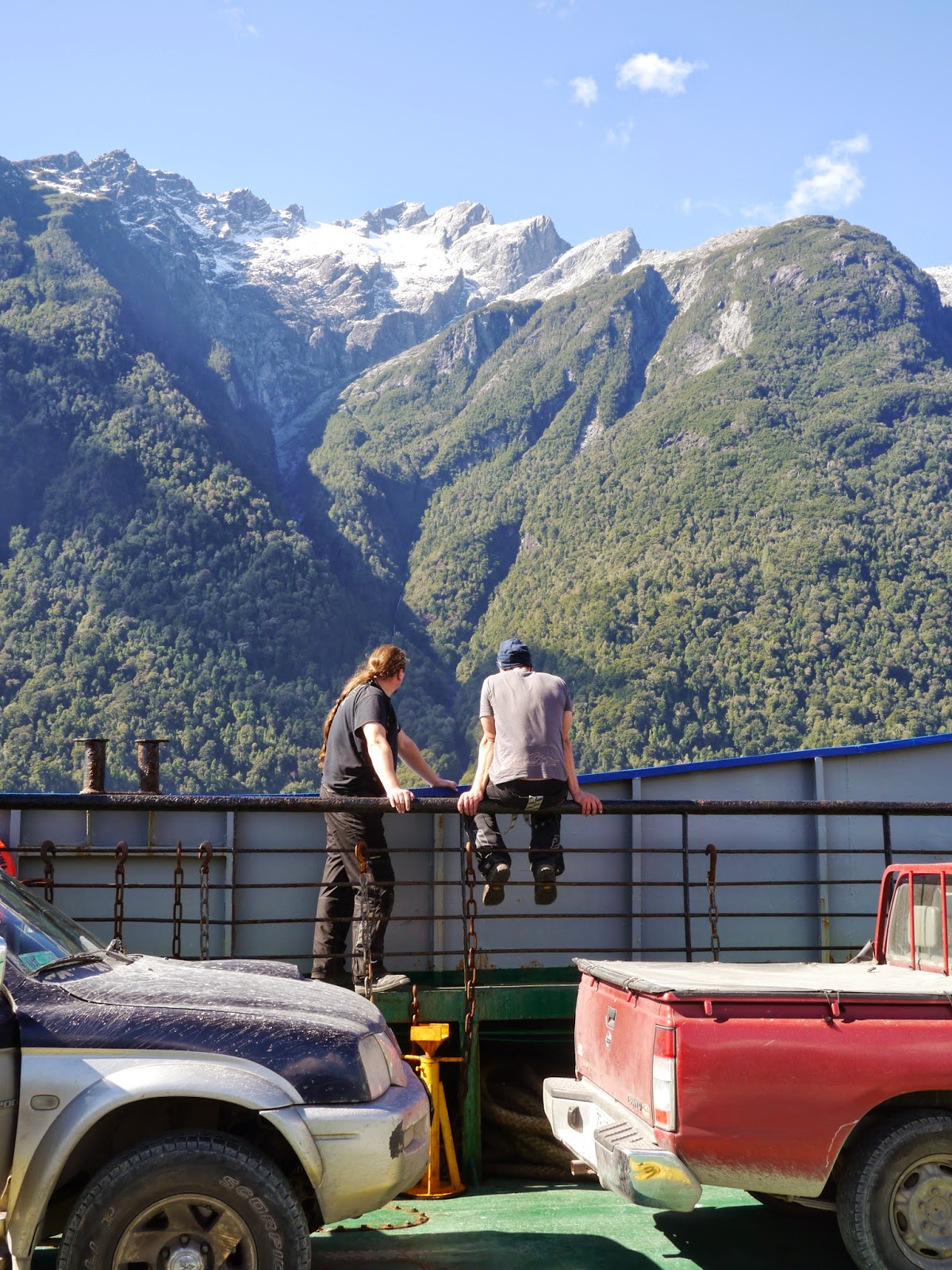
My arrival to Buenos Aires on April 20th marked
the end of my trip through Patagonia, as well as the end of my journey
through Latin America. It has been quite the experience and I could not have asked for a better finale than this road trip.
Day 17
"Woke up to a view of Mount Fitz Roy through the wind shield
of our truck. We had arrived to El Chaltén. Excited to be hiking after two weeks of inactivity. Fall colours
against the backdrop of Fitz Roy the whole way. After setting up camp at its
base, decided to hike to a glacier that caught our eye from the
drive into El Chaltén. Getting there involved an hour or two of bush-whacking through a swamp and
scrambling over loose rocks. But it was worth it. I was in awe of its baby blue
colour and the thunderous sounds it produced as it cleaved. The shore of the glacier
pool was dotted with chunks of ice, some as big as I. It had been days since I
had last showered and the pristine water was just calling my name. It was the coldest water I’ve ever swam in, but being somewhat clean afterward
was well worth it."
 |
| Woke up to this view near El Chaltén |
 |
| Fall colours & Mount Fitz Roy |
 |
| Taking a dip in glacier run off |
Day 18
"Got out of the park just past noon and decided to treat
myself to clean laundry, a bed, and the cheesiest Roquefort pizza in town. Will be back on the road
tomorrow."
Day 19
"Glad to have picked up another longterm hitch-hiker, James from England. Not only can we now split fuel costs four ways, but we can sing along to 'The Proclaimers' in a four-part harmony."
"Hard to believe that the Landruiser was able to handle the sharp turns on the way to Perito Moreno Glacier at double, and sometimes triple, the posted speed limit. We were silent and holding on for dear life as Tom negotiated the windy road of the national park trying to get us to the glacier before the sun set. While the passengers all made it, the truck took a little bit of a beating. The suspension was a little squeakier than usual, one of the windows was stuck, and one of the speakers ceased to work. But we managed to make it just in the nick of time, and had the entire park to ourselves."
"The glacier truly was one of the most amazing sights. It was baby blue, laced with crevasses and stretched as far as the eye could see. The sounds it made as it calved were deafening, and some lasted nearly a minute. Furthermore, it would often prompt the calving of another part of the glacier, perhaps hundreds of metres away."
Day 20
"Last night we ate at an all-you-can-eat parilla in El Calafate. We were stuffed and several bottles of vino deep when we discovered that the restaurant had wifi, fast wifi. As it was the first place in Patagonia that we've managed to find wifi good enough to open our e-mail, all of us, with the exception of James for he lost his cell phone, busted out our tablets and computers and went at it. We were the last people in the restaurant and eventually the staff got fed up and simply shut it off to get us to leave. After Tom and I dropped off Thomas and James at a hostel we decided to park our truck - i.e. mobile home - outside the restaurant in hopes that they reconnected the internet. We were in luck and spent some more time sending e-mails, calling banks, etc."
Day 21
"The streets of Puerto Natales at six in the morning are not what you would expect of a small town in Southern Patagonia... It made for an interesting start to our multi-day hike of the 'W'-trek in Torres del Paine National Park. Due to bad weather forecasts and a time constraint on our road-trip, we opted to do this four to five day hike in three. We traveled lightly the nine kilometres to the lookout point for the towers. The weather was beautiful and we had a great view of the towers at the top. But we only had maybe a half hour to soak it in as we still had the majority of the hike in front of us. We raced down the trail, picked up our packs, and had to set a fast pace for camp if we were going to make it in day light. The wind was incredibly strong. We made it just as the sun was setting and, at the end of the day, we covered about 32 km. Quinoa for dinner."
Day 22
"More hiking, more incredible scenery and more Quinoa..."

Day 23
"The absurd cost of transport to get back to the parking lot at the start of the 'W' trek left us with a bad taste of Torres del Paine National Park. We were further aggravated when we got to the parking lot and the hotel wouldn't sell us any gas. We asked every person in the parking lot if they had any gas to spare. After an hour or two we collected maybe a litre. Decided to push for a small town between the park and Puerto Natales where rumours hold that there is a black market for gasoline. If we didn't make it, two of us would watch over the truck for the night while the other two hitched a ride into town to fill up a gas can. We made it, but the police wouldn't help us and said we'd need to hitch a ride. Finally we found the black market and bought out their whole stock, a whole six litres for more than $12 US. We had doubts that it would be sufficient to take us to Puerto Natales, but we made it with one litre to spare in the tank. Will we never learn..."
Day 24
"Slept at a nice hospedaje last night run by a grandmother named Gloria. Surprised to find the windshield wiper snapped off the car. Used some fishing line to fasten it to the truck. At least it came in use somewhere, for I'm surely not catching any fish with it... After conquering the 'Towers of Pain' (Torres del Paine) we are ready to continue our journey sur, down the 'Road to the End of the World' (Carretera al Fin del Mundo) to 'The Land of Fire' (Tierra del Fuego). I hope the scenery lives up to the expectations set by the epic titles..."
Day 25
"Took a ferry from Punta Arenas to Porvenir, the gateway to Tierra del Fuego. While the road here looked better than most we've been driving, it was by far the worst. The dirt road was saturated with water - it was essentially mud. In 4WD we were sliding off the road into the ditches lining it, getting spun around over 90º at times, and getting covered in mud. It was comparable to driving the worst black ice. This drive would be impossible without a proper truck. Made it to Ushuaia, Argentina."
Day 26
"Today we discovered that Argentinians do not take kindly to British folk. They hold a grudge over the Falkland War and continue to claim the islands are theirs. Signs prohibit 'British pirates' from docking. James is convinced that he is given higher hostel prices once they hear his accent."

Day 27
"Trying to get off the Land of Fire is not easy. Rumours hold that one may be stuck up to 70 hours waiting for the wind to die down before the ferry can attempt the three kilometre crossing. We arrived at night to find a line stretching about two kilometres. And while the ferry was going, it would close in two hours and we would not make it until the next morning. James slept in the drivers seat, I in the passenger seat, and Tom in the back. We were fast asleep when we got woken up and told that there would be one last ferry and its our turn. James has never driven a large truck before and when Tom mentions it's a four speed, James is thrown off, "Is that just like a five speed minus one?!" Half asleep it was a jerky ride onto the ferry, and we almost missed the ramp."
Day 28
"Had to change the tire today for the first time this trip. Discovered that the jack is too small. Made for an interesting, and miserable, tire change in 70 km/hr winds. Sad to see James leave today as well. And, once again, there were two..."
Day 29
"Getting fairly proficient driving a manual transmission, but haven't quite graduated to driving stick with a hot cup of coffee. Tom was asleep and it was my turn. Grabbed a coffee and managed to navigate the parking lot without spilling a drop. My confidence was high. But then I was forced to stop on an uphill before merging on the highway, and, to make matters worse, there was a truck right behind me. I made it fine, but spilled half the cup on my crotch. Curse the lack of cup holders in this Landcruiser."
Day 30
"Arrived to Buenos Aires today. Bittersweet about it. As excited as I am to explore this city which I've heard so much about, it very well be my last day in the ol' Landcruiser. Over the course of the thirty day road trip we've had numerous experiences - some good, some bad and some ugly. It was a journey I surely will never forget."

Day 19
"Glad to have picked up another longterm hitch-hiker, James from England. Not only can we now split fuel costs four ways, but we can sing along to 'The Proclaimers' in a four-part harmony."
 |
| Guanacos |
 |
| Llamas |
"Hard to believe that the Landruiser was able to handle the sharp turns on the way to Perito Moreno Glacier at double, and sometimes triple, the posted speed limit. We were silent and holding on for dear life as Tom negotiated the windy road of the national park trying to get us to the glacier before the sun set. While the passengers all made it, the truck took a little bit of a beating. The suspension was a little squeakier than usual, one of the windows was stuck, and one of the speakers ceased to work. But we managed to make it just in the nick of time, and had the entire park to ourselves."
"The glacier truly was one of the most amazing sights. It was baby blue, laced with crevasses and stretched as far as the eye could see. The sounds it made as it calved were deafening, and some lasted nearly a minute. Furthermore, it would often prompt the calving of another part of the glacier, perhaps hundreds of metres away."
 |
| Perito Moreno Glacier, El Calafate, Argentina |
 |
| Managed to fix the speaker, but no luck with the window |
Day 20
"Last night we ate at an all-you-can-eat parilla in El Calafate. We were stuffed and several bottles of vino deep when we discovered that the restaurant had wifi, fast wifi. As it was the first place in Patagonia that we've managed to find wifi good enough to open our e-mail, all of us, with the exception of James for he lost his cell phone, busted out our tablets and computers and went at it. We were the last people in the restaurant and eventually the staff got fed up and simply shut it off to get us to leave. After Tom and I dropped off Thomas and James at a hostel we decided to park our truck - i.e. mobile home - outside the restaurant in hopes that they reconnected the internet. We were in luck and spent some more time sending e-mails, calling banks, etc."
Day 21
"The streets of Puerto Natales at six in the morning are not what you would expect of a small town in Southern Patagonia... It made for an interesting start to our multi-day hike of the 'W'-trek in Torres del Paine National Park. Due to bad weather forecasts and a time constraint on our road-trip, we opted to do this four to five day hike in three. We traveled lightly the nine kilometres to the lookout point for the towers. The weather was beautiful and we had a great view of the towers at the top. But we only had maybe a half hour to soak it in as we still had the majority of the hike in front of us. We raced down the trail, picked up our packs, and had to set a fast pace for camp if we were going to make it in day light. The wind was incredibly strong. We made it just as the sun was setting and, at the end of the day, we covered about 32 km. Quinoa for dinner."
 |
| Gauchos herding horses |
 |
| Parque Nacional Torres del Paine |
 |
| Los Torres del Paine |
Day 22
"More hiking, more incredible scenery and more Quinoa..."
 |
| The Towers at night |
 |
| Setting up camp |
Day 23
"The absurd cost of transport to get back to the parking lot at the start of the 'W' trek left us with a bad taste of Torres del Paine National Park. We were further aggravated when we got to the parking lot and the hotel wouldn't sell us any gas. We asked every person in the parking lot if they had any gas to spare. After an hour or two we collected maybe a litre. Decided to push for a small town between the park and Puerto Natales where rumours hold that there is a black market for gasoline. If we didn't make it, two of us would watch over the truck for the night while the other two hitched a ride into town to fill up a gas can. We made it, but the police wouldn't help us and said we'd need to hitch a ride. Finally we found the black market and bought out their whole stock, a whole six litres for more than $12 US. We had doubts that it would be sufficient to take us to Puerto Natales, but we made it with one litre to spare in the tank. Will we never learn..."
Day 24
"Slept at a nice hospedaje last night run by a grandmother named Gloria. Surprised to find the windshield wiper snapped off the car. Used some fishing line to fasten it to the truck. At least it came in use somewhere, for I'm surely not catching any fish with it... After conquering the 'Towers of Pain' (Torres del Paine) we are ready to continue our journey sur, down the 'Road to the End of the World' (Carretera al Fin del Mundo) to 'The Land of Fire' (Tierra del Fuego). I hope the scenery lives up to the expectations set by the epic titles..."
Day 25
"Took a ferry from Punta Arenas to Porvenir, the gateway to Tierra del Fuego. While the road here looked better than most we've been driving, it was by far the worst. The dirt road was saturated with water - it was essentially mud. In 4WD we were sliding off the road into the ditches lining it, getting spun around over 90º at times, and getting covered in mud. It was comparable to driving the worst black ice. This drive would be impossible without a proper truck. Made it to Ushuaia, Argentina."
 |
| Tierra del Fuego, Chilé |
 |
| In the 'Land of Fire' |
 |
| Ushuaia, Tierra del Fuego, Argentina. The southern-most tip of South America reachable by road. |
Day 26
"Today we discovered that Argentinians do not take kindly to British folk. They hold a grudge over the Falkland War and continue to claim the islands are theirs. Signs prohibit 'British pirates' from docking. James is convinced that he is given higher hostel prices once they hear his accent."
Day 27
"Trying to get off the Land of Fire is not easy. Rumours hold that one may be stuck up to 70 hours waiting for the wind to die down before the ferry can attempt the three kilometre crossing. We arrived at night to find a line stretching about two kilometres. And while the ferry was going, it would close in two hours and we would not make it until the next morning. James slept in the drivers seat, I in the passenger seat, and Tom in the back. We were fast asleep when we got woken up and told that there would be one last ferry and its our turn. James has never driven a large truck before and when Tom mentions it's a four speed, James is thrown off, "Is that just like a five speed minus one?!" Half asleep it was a jerky ride onto the ferry, and we almost missed the ramp."
Day 28
"Had to change the tire today for the first time this trip. Discovered that the jack is too small. Made for an interesting, and miserable, tire change in 70 km/hr winds. Sad to see James leave today as well. And, once again, there were two..."
Day 29
"Getting fairly proficient driving a manual transmission, but haven't quite graduated to driving stick with a hot cup of coffee. Tom was asleep and it was my turn. Grabbed a coffee and managed to navigate the parking lot without spilling a drop. My confidence was high. But then I was forced to stop on an uphill before merging on the highway, and, to make matters worse, there was a truck right behind me. I made it fine, but spilled half the cup on my crotch. Curse the lack of cup holders in this Landcruiser."
Day 30
"Arrived to Buenos Aires today. Bittersweet about it. As excited as I am to explore this city which I've heard so much about, it very well be my last day in the ol' Landcruiser. Over the course of the thirty day road trip we've had numerous experiences - some good, some bad and some ugly. It was a journey I surely will never forget."
 |
| Tango show in Café Tortoni, Buenos Aires, Argentina |